BACKGROUND: ABOUT A/R/TOGRAPHY
I completed a PhD In Visual Arts and Education titled “Creating Audiovisual Narratives: a/r/tography and inclusivity” (2014). The dissertation looked at inclusivity among children and young people with disabilities through the creation of short animated films using the methodology of a/r/tography. A/r/tography is an arts-based educational research methodology that acknowledges the triple identity, ways of doing and thinking of the artist/researcher/teacher. An a/r/tographic dissertation uses artworks to reflect on learning and teaching experiences. You can see some of the pages of the graphic novel that reflected on inclusivity in the Portfolio section. The mentorship of Prof. Rita Irwin and the supervision of Prof. Ricardo Marín Viadel were essential for this PhD to be completed successfully.
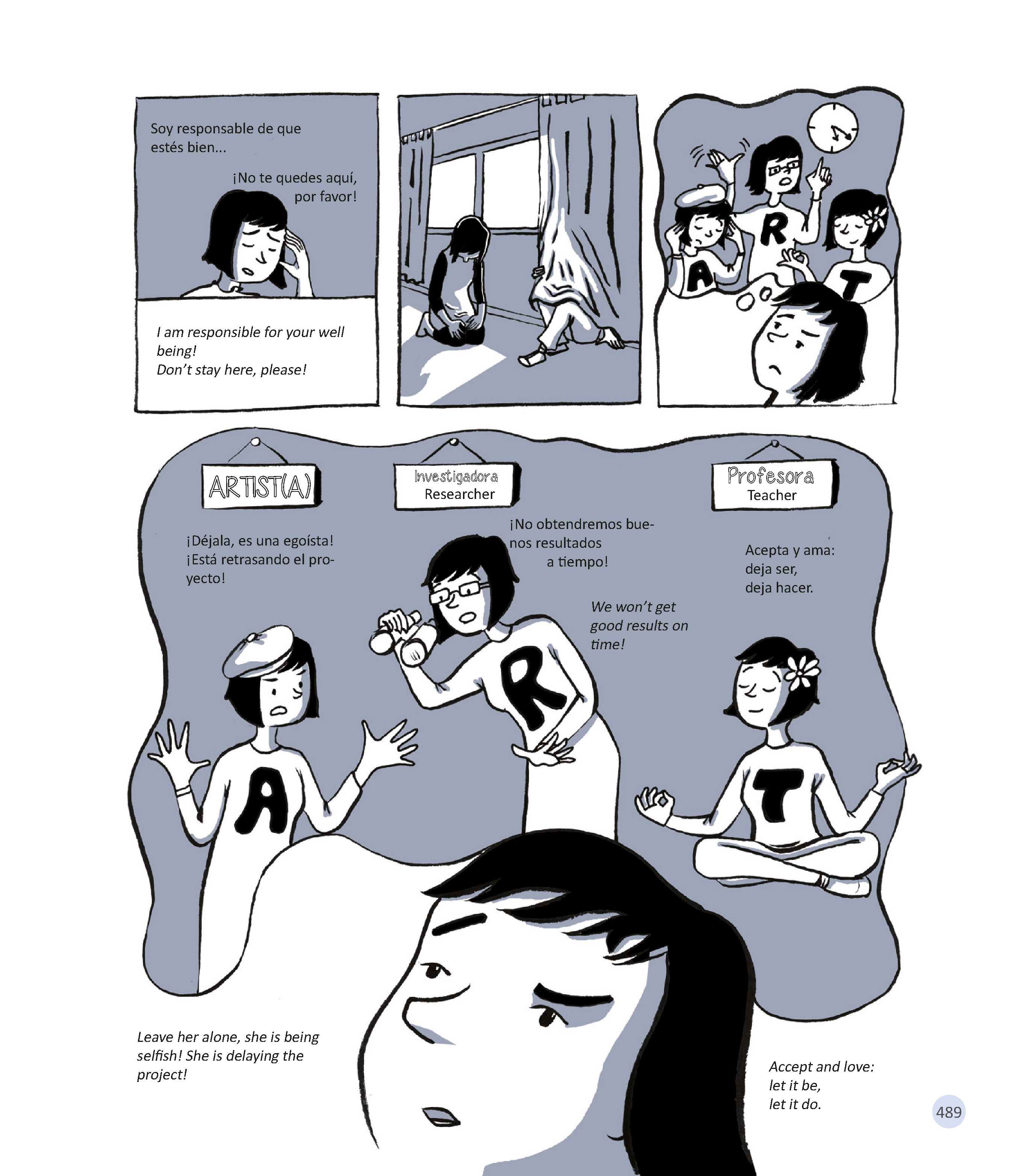
A/r/tography is present in the comic when the main character struggles with her expectations during the workshop. I drew a dialogue between the three characters of the artist, researcher and teacher inside her head to reflect on the tensions between the three ways of being. I used a curvy line in the panel to communicate that this was a mental space. The curvy panel had the three characters -the artist, the researcher and the teacher- with three different voices. This allowed me to reflect on the complexities of inclusivity from the three different identities or point of views, and the strong tensions and differences between them.
INTERNATIONAL SINGLE AUTHOR ARTICLES
2020. Engaging, validating, imagining: a comic-based approach to (non)participation and disabilities. International Journal of Education Through Art 16 (1), 43-61. DOI: 10.1386/eta_00004_1
2014. Inclusivity and Aesth/ethics in Third Participatory A/r/tographic Spaces, Visual inquiry 3 (2), 149-166. DOI: 10.1386/vi.3.2.149_1
2012. Paradox in A/r/tography: Collective Short Animated Film-Making for Social Inclusion. Visual Arts Research 38 (2), 58-68. DOI: 10.5406/ visuartsrese.38.2.0058
2013. Investigando con otros: la investigación en educación artística como praxis de la diferencia. Arte, Individuo y Sociedad, 25 (2), 261-270. ISSN 1131-5598 (Translated article title: “Researching with others: art education research as praxis of difference”).
2012. Sharing our Life Experiences Through Autobiographical Graphic Novels. Visual Arts Research 38 (1), 99-107. DOI: 10.5406/visuartsrese.38.1.0099
RESEARCH PLAN 2023-2026: ABOUT AUTOETHNOANIMATION

I aim to follow the five-year research plan above. The first stage (2023-2026) is focused on the creation of films about personal experience that explore contemporary cultural issues (autoethnoanimation).
Autoethnoanimation is the combination of elements of autoethnography and Animation Practice as Research. Autoethnography is a methodology used in social sciences and education where researchers look at their personal experience as the main source of data to inform a cultural study.
Autoethnography resonates with a/r/tography as living inquiry, where research is a lived and living process of inquiry. In this paradigm, different aspects of the life of the artist/researcher/teacher cannot be separated from the process of inquiry. In that regard, there is no clear boundary between the personal and the professional self, since they are interrelated. This resonates with the feminist phrase “the personal is political”. In a similar way, relational autoethnography acknowledges that the focus on the self is always in relation to others, and never about one alone. My aim is to combine aspects of Autoethnography with Animation Practice as Research and create short animated films based on my experience while exploring cultural social issues.
ABOUT “BECOMING A LECTURER”
My first autoethnoanimation, “Becoming a Lecturer” is in current process of development. It is an allegory about my professional journey into Higher Education. My aim is to explore the struggles with job insecurity and mental health through Animation. A career within Academia seems to be attributed with prestige and an aura of privilege. There does not seem to be much awareness about the mental health issues frequently experienced in the job. There seems to be a mysterious secrecy about the reality of overworking in academia and the difficulty to find work-life balance in extremely demanding working environments. Anxiety and stress have been frequent mental health issues in my experience while working as a lecturer in Higher Education. I believe this is not just because of a personal vulnerability, but a systemic problem created by excessive and unrealistic demands within the job.

Character design for act 1: the aspiration. Part of the short autoethnoanimation “Becoming a Foreigner”.
ACT 1: THE ASPIRATION
The short film “Becoming a Lecturer” uses different animation methods in three acts that correspond with different stages in my professional life. I use different animation approaches in the different acts. Act one is about the motivation or aspiration to become a lecturer. A girl dressed as a superhero is willing to show her dog that she can fly in her bedroom. This is a metaphor representing the almost impossible aspiration to make art, research, and teach. I aim to provoke a reflection on the paradoxical aspects of a/r/tography. This is, the triple identity is enabling artistic ways of being in academia while evidencing the impossibility of conducting simultaneous activities as an artist, researcher, and lecturer. In other words, wanting to be an a/r/tographer feels like a nine year old wanting to fly. The dog symbolises all the supportive people that have allowed me to persist as I failed repeatedly to fulfil the highly ambitious objectives of the professional path while trying to maintain work-life balance.

Frame from act 1: the aspiration. Becoming a Foreigner.
ACT 2: DOCTORATE STUDIES
In Act 2, the character arrives to ABC University. She finds a book in the library with a tag that says “read me”. Reading the book makes her shrink, like Alice in Wonderland. Libraries have always made me feel small. I found that amount of knowledge impressive and overwhelming. The more I learnt, the more I was aware I would never know as much as I wanted to. Even though she is smaller now, there is still something enthusiastic about learning. This is represented through the human character reading the book and making a dancing move. She is so empowered through knowledge, that she becomes a tiger after the dancing movement. But soon, the exciting and stimulating experience of learning becomes frustrated by the pressure of a circus audience expecting the wild tiger to jump through the hoop on fire. The “domesticating” systems, procedures, structures, formats and traditions in academia are represented by the hoop:
The result of going through the hoop or conforming to institutional requirements takes to another metamorphosis of the tiger into an exhausted human being. As she lands on the floor, the character suddenly finds herself in a supermarket trolley. The supermarket is a symbol of the alienating experience of courses operating as products or commodities to be sold to students, who are considered clients. This is a critique of pedagogical paradigms, theories and methodologies becoming commodities to be consumed in neoliberal systems. As the character climbs the trolley full of groceries with the name of key authors and theories, she arrives to an unsettling view. There is a big queue that ends in a job center. All the efforts point at job insecurity. This was my experience completing a PhD in a country after a big economic crisis with scarcity of professional opportunities.
Act three and four are in development and will reflect on the stages of the first jobs in academia and working in Higher Education after the Pandemic.
ABOUT FUTURE AUTOETHNOANIMATIONS
I would like to produce three additional autoethnoanimations on different subject such as being a foreigner, growing up as a woman, and scuba diving.
ABOUT ANIMATED DOCUMENTARIES
After these four films, I would like to produce animated documentaries about female ocean conservationists connecting my passion for scuba diving with animation.
ABOUT ARTISTIC VALUE
I invite students to reflect on their own vision of Animation. The image below is my synthesis of what I find valuable in an Animation Practice as Research:

In my vision, there are six aspects that provide an animated project with artistic value within the artist’s area of control: the intention or motivation behind the project, the aesthetics or design constraints, the animation methods used in relation to the concept to be explored, the narrative strategies, and the experience to be provided for the intended audiences.
I see value in a production that is touching for people and it’s found to be insightful by the audience but the artist or author may not have so much control over the audiences’ reactions. Ideally, the production has the desired circulation and transformational impact on the public, but the director may not have so much control over this either.
It’s worth focusing in what the director-author can have more control or influence over and learn from the different outcomes.